Three ways to look again at a familiar place
These exercises grow out of the questions guiding the Tierra Viva gathering at Palma Serena in Todos Santos. Try them in a garden, on a farm, or with a plant in a pot. You don’t have to attend, register, or have any previous experience. A notebook and pencil are enough to begin.
01 · At the edge of a bed
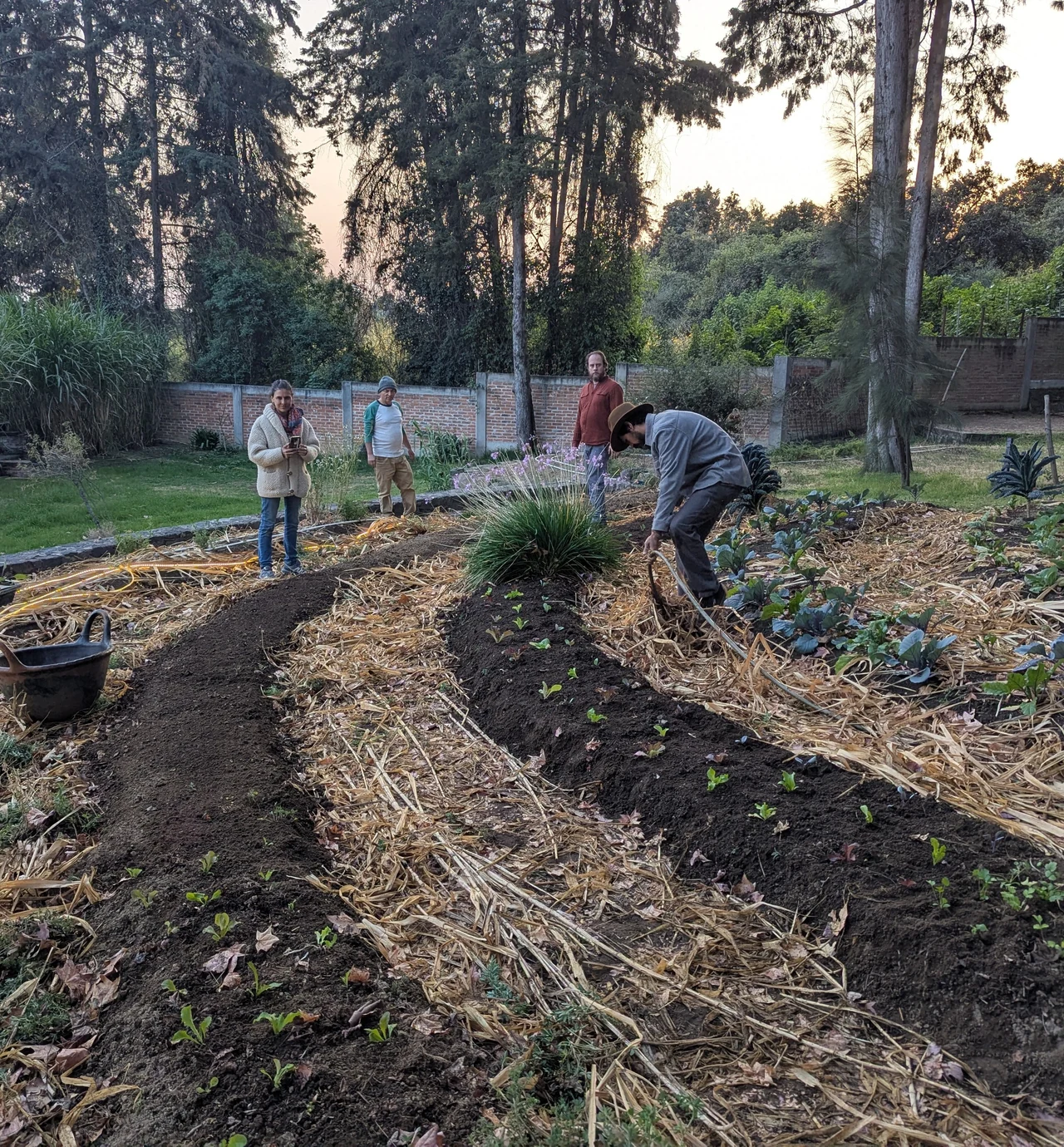
A garden doesn’t behave the same way from one end to the other. Rather than let one handful of soil stand for the whole place, compare two points close together: perhaps the edge of a bed and the soil at the foot of a plant.
- Note the time, when each spot last received rain or irrigation, and whether it’s in sun or shade. On someone else’s farm, ask before disturbing the soil.
- Brush aside a little of the surface litter. Describe the smell, the plant material, and whether a small crumb of soil falls apart under your fingers or holds together. Look for fine roots between crumbs. Describe each spot separately before comparing them.
- Return after the next rain or watering. Record what repeats and what disappears. Don’t assign the difference to a preparation or a change in management without further observations.
In your notebook: What changed with moisture, and what still distinguished the two spots?
02 · Follow the water
One question can guide a walk in the landscape around the Todos Santos oasis: where does water move, and where does it pause? You can ask the same question in your own garden without changing the ground or adding water.
- Sketch slopes, paths, plants and bare ground. Use dotted lines to show where you think the water will go.
- After rain or ordinary irrigation, walk the site when it’s safe. Look for displaced leaves, silt, puddles and damp edges. Mark where you actually saw flow separately from where you inferred it from a trace.
- Put those observations on the same sketch in another color. Choose one place where the prediction failed. Go back after another watering before deciding whether to change anything.
In your notebook: Where did the path you observed depart from the path you imagined?
03 · Two images before an explanation
The gathering includes work with circular soil chromatograms. For this exercise, use two finished images; there’s no need to handle reagents. The point is to separate what an image shows from what we’d like it to prove.
- Look at both images in the same light. If you know where the samples came from, cover their labels first. Describe the center, the transitions toward the edge and any abrupt breaks in the pattern.
- Sketch each image on its own. If you’re working with someone else, compare notes before uncovering the labels. Mark where you agree and where you noticed different things.
- Read the sample notes and compare them with what you know about the field. One image does not measure nutrients or diagnose fertility. Turn a difference into a question you can pursue with repeated field observations or, where appropriate, a soil test.
In your notebook: Which observation deserves a check in the field, and how would you make it?